

Renewable Energy - Yes There Are Advantages
Wednesday, March 16, 2011
While many of the fossil fuels continue to be in short demand in every corner of the world, people including governments and individuals concerned with the environment are starting to make the rest of us more aware, that these supplies will simply be gone at some point.
Many concerned people and numerous governments are looking for ways to utilize renewable energy and how this source of energy really will work most effectively.
 Fossil fuels are also responsible for many of the biggest problems with the environment.
There have been many studies that link the state of the environment with the use of fossil fuels. Global warming is one of the biggest problems we are facing and both human and animals are impacted by changing weather patterns. The earth is getting hotter and this is being experienced in many places. Wild weather like hurricanes and severe droughts are among the serious consequences of global warming.
You can find a great deal of education in the movie 'An Inconvenient Truth' on the damage that global warming is causing. Normally you can find this video at any video /DVD rental location or movie download. This movie is a great surprise and you may find that this can change the way you live, because hopefully you will appreciate that a green power source must be something that we all will eventually need to incorporate into your own homes.
Right now there are many small changes you can make that can really add up.
A big advantage of most renewable energy sources is that they help to reduce the carbon footprint that each of us is leaving. Solar power, geothermal energy and wind power are some examples of how we can use clean energy sources, and this can help us to be on the leading edge of this growing movement.
Jobs in the United States are created when more people use alternative power sources and these are jobs that are unlikely to leave the US. Many of the positions available for these jobs will have a great pay base as well as benefits.
There are tax credits that are being provided and this is a major benefit provided to help people begin using green energy. This and other incentive programs are starting to make it easier for many more people to afford renewable energy programs. Some of the tax cuts give the consumer up to 30 percent of their solar installation and this is valuable for both commercial and residential consumers.
When alternative energy is affordable for all, more consumers will make this change in their home and begin using green energy technology, to help lessen the impact of global warming.  Those who use renewable energy are likely to spread the word about living a greener life and this can help entire communities.
An environmentally sound community can help and guide others on how to be the most efficient in daily life. Getting guides and policies in place can help other people find and stick to a green power system that will cut down on pollution and serious environmental damage to our planet.
You can start with National Geographic. They provide a great guide called the "Green Guide". It contains solid information that someone can use to live their best green life. If your city is not already listed in this guide -- get your city listed.
People could write for quite some time about the advantages of renewable energy. However, you may also want to know about some disadvantages of renewable energy. The major disadvantage is of course the cost of any alternative power source. It is still too much of an expense for many consumers. So many are waiting for the costs to lower, because the $20,000 needed for a PV solar system means it's probably not available for many consumers.
This article is contributed by Alice Shaw. He is an ardent promoter of green living and environmental protection. If you are itching to learn more about alternative energy, you are welcome to visit his site: http://ardentgreenliving.com. You will get more green energy info.
To guess post in this blog, please contact me. You are welcome to do so to share ideas, information, experience and others related to chemical engineering industry. I look forward to receive your article... :)



Have you downloaded my free "Choosing Alternative Fuel" Ebook? If not, then please download it here. It's Free and on top of getting the free ebook, you'll get eCourse on Alternative Fuel. It's a good and easy way to add more valuable information to yourself.
Labels: Biofuel, Biotechnology, Chemical Engineer, Environmental, green, Learning Curve, News, Processing., renewable, Review, Solar, Technology
posted by Kipas Repair JB @ 8:09 PM,
,

Progressive Freeze Concentration Research
Friday, July 23, 2010
 Before the VIVA starts
The VIVA started at 9.30 am. We arrived at the examination room at 8.30 am to prepare and set up all that are necessary. The VIVA session ended at about 12.15 noon and she passed her Ph.D with minor correction.

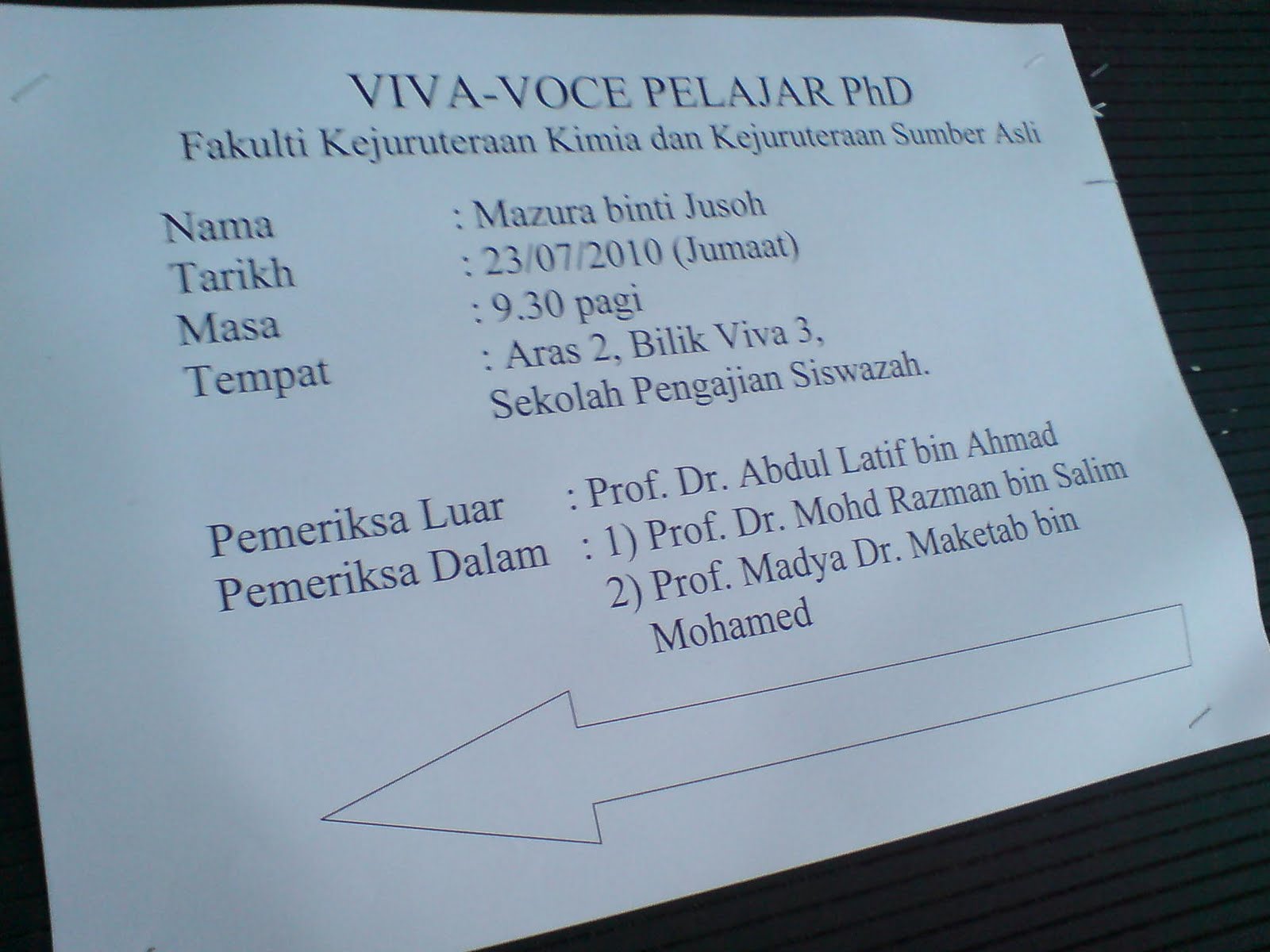
In case you are wandering what is this research all about, here is the abstract of the study. Maybe some of you who are interested can collaborate with Dr. Mazura or become her student to further develop the PFC technology which is the first in Malaysia.
Abstract : DEVELOPMENT OF A NOVEL DESIGN FOR PROGRESSIVE FREEZE CONCENTRATION PROCESS
Industrial wastewater may well be treated by freeze concentration, a process which freezes or crystallises out water content as pure ice crystals and leaves behind a highly concentrated solution in a smaller volume. In conventional suspension freeze concentration (SFC) where ice crystals formed as a suspension in the mother liquor, separation of the solid-liquid mixture is difficult and costly. The size of ice crystals is still very limited and the seeding process requires usage of scraped surface heat exchangers (SSFE), which is significantly expensive and accounted for approximately 30% of the capital cost. Progressive freeze concentration (PFC) invented later is believed to provide cost saving and simplify the subsequent ice-liquid separation as ice crystals are formed as a layer or a block on the cooling surface. Quest for a design providing convenience and good efficiencies continues, and in this study a helical structured copper crystalliser was developed and fabricated named Multi-wind Crystalliser (MWC). Effects of several operating conditions on the performance of MWC in context of wastewater treatment were then investigated including circulation flowrate, initial solution concentration, coolant temperature and circulation time. The performance of the design was evaluated by three dependent variables including the effective partition constant, K, calculated from the volume and concentration of the solid and liquid phase. Two other parameters were ice purity and solution volume reduction. A process optimisation was also performed thereafter employing STATISTICA to produce optimum conditions in favour of the stated independent variables. As the crystalliser designed involves heat transfer, the overall heat transfer coefficient was also calculated through temperature profiling subsequently generating a prediction model for ice crystal mass. At the end of the research, a new crystalliser design for PFC is established and an observation of how the operating conditions affect the performance of the system was obtained. Optimum operating conditions was determined by process optimisation and an overall heat transfer coefficients were also generated. Adequacy and reliability of the ice crystal mass prediction model produced was proven by error analyses revealing relatively small errors.
Now...It's my turn to complete my Ph.D... :)
-------------------------------------------------------------------



 Have you downloaded my free "Choosing Alternative Fuel" Ebook? If not, then please download it here. It's Free and on top of getting the free ebook, you'll get eCourse on Alternative Fuel. It's a good and easy way to add more valuable information to yourself.
Labels: Chemical Engineer, Chemical Engineering, pH.D, Review, Study
posted by Kipas Repair JB @ 6:30 PM,
,
Write to Market Your Expertise
Wednesday, March 24, 2010
For your information, I’m the type of person who loves to write and share. I have been doing that since I was in primary school. That trait has been continuously carried on until I became an engineer where I no longer have a platform to write and share. However, everything changes in 2006 where I found a new platform for me to write and share. That year I started this blog and it has been actively updated until today. I’m very happy with the responses and feedback that I received from the readers of Chemical Engineering World blog.
What I would like to highlight here is the fact that as an engineer, there’s an importance for us to share information, updates and experiences. There are several places where we can share our thoughts and knowledge, for instance, we can share it in a blog, forum, engineering magazine, newsletter, book, book chapter, report, article and so on. There are also professional engineering societies such as Institution of Chemical Engineers (IChemE), American Institution of Chemical Engineers (AIChE), Institution of Engineers Malaysia (IEM) Chemical Engineering Division and others that you can share with. This is very important as this can expose you to the world. You have certain capability that other engineers might not possess and that shows how unique you are. You need to market yourself and your expertise. When you successfully market yourself, people will know who you are and there will be somebody who may need your help and professional service.
I’m lucky because I’m blessed with a little spare time to write my thoughts and experiences, especially in blog. I don’t consider myself an expert in any chemical engineering discipline, but the funny thing is many people acknowledge my existence and these people come from all over the world. This was done unintentionally. I never planned for this. My thought in the first place when I started this blog was too only share experiences and knowledge. That’s all. But, my sharing has rewarded me with pure satisfaction. I’ve made more friends, more contacts and more credibility. That’s the truth. That’s what I’ve been telling a friend of mine who is an expert in waste management. “You got to share and market yourself”. “Write good articles, reports and essays about your expertise in waste management”. People will know and identify you as the expert in that field and may demand for your service.
But then, the popular limitation or excuse such as no time takes place. That’s when I think we need to act intelligently to overcome the weaknesses. If you can’t afford to spare some time to write, you need to leverage or ask other people to do it for you. This is why and the main reason people become successful. They can’t do everything by themselves. They are not superman. Hence, they ask for some help. They seek for other people’s services or help them do part of their work. Maybe they have their own downline manpower, junior engineer, senior clerk and so on.
If in any case, this is not available, you can just key in write my essay in google search box and seek for freelance services that can do the job for you. Imperatively, you need to provide the points and guideline to those people so that they know what type of content you want in order to complete your custom essay or article. Having a professional doing an essay or article on your behalf and publishing them in related magazine, blog, website or newsletter will create positive impact in terms of marketing yourself. You won’t believe it but by doing such a simple thing such as publishing article, essays or report displaying your expertise, you’ll be surprise when out of a sudden, people contact you, consulting you on issues related to your expertise. Just try it out…Start publishing your expertise.
Labels: Chemical Engineer, Experience, green, pH.D, Review, Study, Training
posted by Kipas Repair JB @ 4:09 PM,
,
1st Annual World Congress of Catalytic Asymmetric Synthesis-2010 (WCCAS-2010)
Tuesday, March 09, 2010
As a person who is involve in reaction and catalysis engineering, I feel I need to share this announcement. For the first time ever, the Annual Congress of Catalytic Asymmetric Synthesis is going to be held. This is the first such conference being organized and to know further details, please read the following which was adopted from an email from the organizer:
What is WCCAS about?
The 1st Annual World Congress of Catalytic Asymmetric Synthesis-2010
(WCCAS-2010) will be held from May 19 to May 21, 2010 in Beijing, China,
with a theme of ‘Create Bioactive Molecules Green and Economically’. This
is a focused event on Catalytic Asymmetric Synthesis, it aims to stimulate
interactions among academia, industry and researchers in this field to
exchange up-to-the-minutes information and promote their novel
technologies. On behalf of the organizing committee of WCCAS-2010, we
cordially invite you as a speaker at Track 4-2: Asymmetric Synthesis of
Biocides or Pesticides to present and contribute your invaluable
experience.

Scope
WCCAS-2010 is expected to greatly contribute to the promotion of new concepts for the development of efficient methodologies for catalytic asymmetric synthesis and its practical applications. The topics will reflect this general theme, placing emphasis on aspects that are common to all areas of catalytic asymmetric synthesis and the type of reaction involved:
Track 1: Novel Technologies for Catalytic Asymmetric Synthesis
Track 1-1: Rational Ligand Designs and Novel Catalyst Screening
Technologies
Track 1-2: Microwave/Ultrasonic/Photo Assisted Asymmetric Catalysis Track
1-3: Practical Chiral Catalyst Immobilization
Track 1-4: Nanotechnologies in Asymmetric Catalysis
Track 1-5: Non Air Sensitive or On-water Catalysis and Solid Phase Catalysis
Track 2: Organometallic Chiral Catalysts in Asymmetric Transformations
Track 2-1: Catalytic Asymmetric Alkylation
Track 2-2: Catalytic Asymmetric Additions
Track 2-3: Catalytic Asymmetric Hydrogenation and Reductions
Track 2-4: Catalytic Asymmetric Oxygenation
Track 2-5: Catalytic Asymmetric Carbon-Carbon Bond Formation
Track 2-6: Catalytic Asymmetric Epoxidation
Track 2-7: Catalytic Asymmetric Aziridination, Cyclopropanation and
Diels-Alder Reaction
Track 2-8: Catalytic Asymmetric Carbonylation
Track 2-9: Catalytic Asymmetric Amination and Introduction of Other Hetero
Atoms
Track 2-10: Catalytic Asymmetric Polymerization Reactions

Track 3: Enantioselective/ Diastereoselective Organocatalysis
Track 3-1: Chiral Lewis Base Organocatalysts
Track 3-2: Chiral Bronsted Acid Organocatalysts
Track 3-3: Peptide Based Chiral Organocatalysts
Track 3-4: Phase Transfer Chiral Organocatalysis
Track 3-5: Other Organocatalysis in C-N, C-O and C-C Bond formations
Track 4: Applications of Catalytic Asymmetric Synthesis
Track 4-1: Asymmetric Synthesis in Drug Discovery and Processing
Track 4-2: Asymmetric Synthesis of Biocides or Pesticides
Track 4-3: Synthesis of Chiral Unnatural Amino Acids and other Natural
Products
Track 4-4: Enantioselective Synthesis of Analytical Chiral Compounds and
Intermediates
Track 4-5: Asymmetric Synthesis of Optical and other Special Functional
Materials
Track 5: Biocatalysis for Asymmetric Transformations
Track 5-1: Mild to Extremophilic Enzymatic Catalyzed Transformations
Track 5-2: Enzymatic Catalytic Degradations of Biopolymers and Chemical
Polymers
Track 5-3: Microbial and Antibody Catalyzed Asymmetric Reactions
Track 6: Business Development for High Value Chiral Molecules
Track 6-1: Enabled Enantioselective Catalysts on Market
Track 6-2: Purification and Analytic Instrumentation of Enantio-pure
Compounds
Scientific Program
The scientific program will consist of plenary and keynote lectures,
approximately 30 sessions, exhibition and a poster session.
More program information can be found at:
www.bitlifesciences.com/wccas2010
Abstracts of the lectures and posters will be printed in the Conference
Proceedings, which participants will receive at the registration desk and
is included in the registration fee.
Location
The capital city of the People’s Republic of China, Beijing is a
fast-growing, dynamic metropolis that, while courting foreign businesses
and visitors, maintains a firm grip on its rich cultural heritage. Beijing
made history in 2008 with the first Olympic Games ever to be held in
China. The conference will be held in Beijing International Convention
Center (BICC) which is located within the magnificent Asian Games Village.
It is one of the Chinese biggest facilities specifically designed for
conferences and exhibitions, comprising 50 conference halls and meeting
rooms equipped to serve a wide variety of purposes with the capacity from
10 up to 2500 people.
Looking forward to seeing you in Beijing in May, 2010
Sincerely Yours,
Ryan
Program Coordinator
26 Gaoneng St., R405, Dalian Hightech Zone
Dalian, LN 116025, China
Tel: 0086-411-84799609-811
Fax: 0086-411-84799629
Email: ryan@webbitmail.cn
Website: http://www.bitlifesciences.com/wccas2010
1. Are you interested in delivering a speech in this congress? Which session?
2. Would you like to chair or co-chair any session of this conference?
Session details PS: http://www.bitlifesciences.com/wccas2010/program.asp
Labels: Chemical Engineering, Chemistry, Conference, Review
posted by Kipas Repair JB @ 2:51 PM,
,
International Conference on Process Engineering and Advanced Materials 2010 (ICPEAM2010)
Saturday, January 30, 2010
For those researchers who are hunger to present, publish and show case their work, here is a fantastic conference where you can submit them to - The International Conference on Process Engineering and Advanced Materials 2010 (ICPEAM2010). For me, yes, I'm thinking of submitting a paper to this conference and I'm working on it. I have also discuss this matter with my supervisor... :)

The ICPEAM2010 under the World Engineering, Science & Technology Congress (ESTCON2010) will be held on 15th to 17th June , 2010 in Kuala Lumpur, Malaysia. In conjunction with this conference, we are also announcing the 24th Symposium of Malaysian Chemical Engineers (SOMChE 2010). ICPEAM2010/SOMChE 2010 is organized by the Chemical Engineering Department, Universiti Teknologi PETRONAS (UTP).
Objectives
 The objective of this conference is to provide an international forum to present and discuss recent progress in both fundamentals and applications for a wide range of interdisciplinary domains which include material science and engineering, nanotechnology, environmental technologies, process system engineering, reaction and separation engineering, etc.
Materials and Processes in Harmony: Recipe for Sustainable Development
The papers contributed to this conference will cover experimental works, theoretical modeling/simulations, novel approaches in materials synthesis, characterization techniques and applications.
Authors are invited to contribute papers that include but not limited to the following scope:
• Ionic Liquids
• Bio-fuels
• Environment
• Catalysis and Reaction Engineering
• Reactor Technology
• Advanced Material Development
• Advanced Process Control
• Process System Engineering
• Process Safety
• Separation
• Biotechnology
All papers will be peer-reviewed and selected for publication in Journal of Applied Sciences, Asia-Pacific Journal of Chemical Engineering (on Resource Planning and Conservation) and International Journal of Environmental Engineering.
Authors are invited to submit full papers of maximum six (6) pages describing original,  previously unpublished and complete work, addressing state-of-the-art research and development in the above areas. Guidelines for online submission and other information are available at the conference website http://www.utp.edu.my/icpeam2010.
I'm trying to prepare a paper to be submitted for this conference. The due date to submit your paper is 31st January 2010. Yes, I know, it's just around the corner...it maybe too late but just work on your paper and try to send it to the organizers as soon as you can. Who knows maybe they can still accept your paper?
FREE Recommended magazines to get you updated with current engineering news

Labels: Chemical Engineer, Chemical Engineering, Conference, Research, Review
posted by Kipas Repair JB @ 1:49 AM,
,
Plastic Types, Characteristics and ... Dangers!!!
Tuesday, June 30, 2009
Individuals have a way to identify the type of plastic in many products, especially food storage containers and packaging [Check out the video below... interesting]. Many, but not all, such plastic products have a number – the resin identification code – molded, formed or imprinted in or on the container, often on the bottom. This system of coding was developed in 1988 by the U.S. - based Society of the Plastics Industry to facilitate the recycling of post-consumer plastics. It is voluntary for plastic manufacturers, but has become relatively standard on certain plastic products sold globally. Knowing the code for a particular product, consumers can then inform themselves of the characteristics of the plastic and the risks of using that product.
The seven plastic resin codes are each briefly described below to provide a quick snapshot detailing the name of the resin (i.e., the base material of the plastic), typical products it is found in, dangerous chemicals it leaches, and why they are dangerous.Polyethylene terephthalate (PET or PETE) – Used in soft drink, juice, water, beer, mouthwash, peanut butter, salad dressing, detergent and cleaner containers. Leaches antimony trioxide and di(2ethylhexyl) pthalate (DEHP). Workers exposed to antimony
 trioxide for long periods of time have exhibited respiratory and skin irritation; among female workers, increased incidence of menstrual problems and miscarriage; their children exhibited slower development in the first twelve months of life. The longer a liquid is left in such a container the greater the concentration of antimony released into the liquid. DEHP is an endocrine disruptor that mimics the female hormone estrogen. It has been strongly linked to asthma and allergies in children. It may cause certain types of cancer, and it has been linked to negative effects on the liver, kidney, spleen, bone formation and body weight. In Europe, DEHP has been banned since 1999 from use in plastic toys for children under the age of three.
Check out the video below to learn how plastic bottles are made from Polyethylene terephthalate - interesting stuff!!!

 bottles, cooking oil and peanut butter jars, detergent and window cleaner bottles, shower curtains, medical tubing, and numerous construction products (e.g., pipes, siding). PVC has been described as one of the most hazardous consumer products ever created. Leaches di(2-ethylhexyl) phthalate (DEHP) or butyl benzyl phthalate (BBzP), depending on which is used as the plasticizer or softener (usually DEHP). DEHP and BBzP are endocrine disruptors mimicking the female hormone estrogen; have been strongly linked to asthma and allergic symptoms in children; may cause certain types of cancer; linked to negative effects on the liver, kidney, spleen, bone formation and body weight. In Europe, DEHP and BBzP and other dangerous pthalates have been banned from use in plastic toys for children under three since 1999. Not so elsewhere, including Canada and the United States.


 Important Note : Two other types of plastic that fall under code 7 are acrylonitrile styrene (AS) or styrene acrylonitrile (SAN), and acrylonitrile butadiene styrene (ABS). Both AS/SAN and ABS are higher quality plastics with increased strength, rigidity, toughness and temperature and chemical resistance. AS/SAN is used in mixing bowls, thermos casing, dishes, cutlery, coffee filters, toothbrushes, outer covers (printers, calculators, lamps), battery housing. The incorporation of butadiene during the manufacture of AS/SAN, produces ABS,
  which is an even tougher plastic. ABS is used in LEGO toys, pipes, golf club heads, automotive parts, protective head gear. Our research on risks associated with AS/SAN and ABS is ongoing.
WHAT THIS MEANS FOR YOUR EVERYDAY PLASTIC USE : You may wish to seriously consider your – and especially your children's – use of plastics numbered 1, 3, 6 and 7 (polycarbonate), all of which have been shown to leach dangerous chemicals. This does not necessarily mean the others are completely safe, just that they have been studied less to date.

So if you have to use plastic, it is safest to stick to numbers 2, 4, 5 and 7 (other than polycarbonate) whenever possible.
If an item does not have a plastic code on it, or if the type of plastic is unclear from the code (e.g., with #7, it likely will not say it is polycarbonate), your best bet is to contact the manufacturer and ask them directly what type of plastic was used to make the product.
Plastic Tips
Here are some simple tips to help you in working toward a life without plastic, or a life of safer, more informed plastic use.
o Avoid polycarbonate (#7) baby bottles and sippy cups. For baby bottles, try and use glass, polyethylene or polypropylene instead. Sippy cups made of stainless steel (e.g., Kleen Kanteen, Purica), or of polypropylene or polyethylene are safer. Be sure to check the bottle or cup to be sure of the type of plastic it contains. As for baby bottle nipples, try and use silicone which does not leach the carcinogenic nitrosamines that can be found in latex.
o If you must use polycarbonate (#7) bottles, avoid heating food and drink in the bottle. Heat it in a separate container and transfer it to the bottle once it is warm enough for the child to eat or drink. If the plastic is showing signs of wear – scratched, cloudy – discard the container.
o For drinking water, try and avoid plastic bottles. If you do use plastic bottles made from #1 or #2 plastic try not to reuse them as they are intended only for single use. One alternative is a stainless steel water bottle. For storing large quantities of water, glass and stainless steel containers are also available. If you use a #1 water bottle, try to consume the contents as soon as possible because leaching of antimony increases with time.
o Try to avoid heating foods in plastic containers, especially in the microwave oven, which can cause the plastic to degrade and leach chemicals faster. As well, leaching increases when plastic comes into contact with oily or fatty foods, or when the plastic is scratched, worn, cracked, or sticky.
o Use plastic wraps with caution, especially in the microwave, and try to keep the plastic from touching the food. Alternatives include wax paper or paper towels.

o Try and use alternatives to plastic packaging and storage containers. Cloth, paper or cardboard are possibilities for transporting groceries. Stainless steel and glass food storage containers are available.
o Avoid plastic dishes and utensils for meals. Alternatives include glass, ceramic, wood, stainless steel, and lacquer ware. Offer your child or grandchild a non-plastic dish set made of either stainless steel or wood (safely coated with a non-toxic lacquer).
These days, plastic is so omnipresent it can be difficult to imagine life without plastic. Yet, our ancestors managed just fine without it. All it takes is a little imagination, determination and discipline.
p/s: This article is adopted from a colleague who shared this information in my work mailing list. I'm not sure where the information originates. However, I felt that the article is very informative and should be spread. I searched for some related photos to provide better comprehension and visualization to the reader. Hope you like it. I hope it is beneficial to everybody.
...........................................................................................................................................................
Recommended: Free Technical / Engineering Magazine.
Join Chemical Engineer Rocks FACEBOOK Group...
Labels: Health, Learning Curve, Review
posted by Kipas Repair JB @ 8:28 PM,
,
Next Generation Energy System
Monday, April 27, 2009
Tokyo Gas is proposing next-generation energy systems to meet future energy needs and changing environmental conditions, and has put forth an image of what cities will look like in the year 2030.
Traffic infrastructure will make cities more compact with commercial and residential areas growing closer, and cities will be much more user friendly for senior citizens. There will be advances in the adaptable, shared use of energy on a variety of fronts, as well as advances in energy efficiency.
Traffic infrastructure engineering will introduce improvements to cope with natural disasters, and efforts will focus on designing so-called "Energy Security Areas" in the heart of cities that will feature high-level disaster prevention measures.
Cities in 2030 will advance the use of renewable energy sources, and in addition to preexisting energy facilities they will incorporate districts that showcase the intensive use of renewable energy, and carbon dioxide free environment promotion districts.
Not only will large-scale structures and public infrastructure utilize renewable energy sources, the average home will also feature the use of solar cells and solar thermal panels in conjunction with home-use fuel cells.
Interested to learn more about it? Then, what are you waiting for, check out the video below:
Labels: Energy, Review, Solar, Video
posted by Kipas Repair JB @ 9:32 PM,
,
International Journal of Environmental Engineering Science (IJEES)
Wednesday, February 11, 2009
CALL FOR PAPERS...
International Journal of Environmental Engineering Science (IJEES) is a new journal related to environmental engineering sciences. Interested authors are invited to submit their papers to this new journal and if you are interested, please continue reading.
IJEES will be launching their first edition soon with special issue on: "Theoretical and Experimental Research on Air, Water and Soil Pollution". Guest Editors include Dr. Mohanad El-Harbawi, Prof. Binay K Dutta, Dr. Munjed Maraqa, Dr Chun-Yang Yin, Dr Mikhail Robert Savory and Prof. Yung-Tse Hung.
(A) Original research paper or reviews are invited in the following and related areas:
- Air, water and soil pollution fundamentals and applied aspects
- Meteorology, climatology, air quality, hydrology, water quality and water management
- Consequences of air, water and soil pollution on human health
- Toxic and radioactive pollution
- Waste treatment and management
- Air, water and soil control and management
- Environmental chemistry and biology, pollution control and abatement technology
- Studies on inland, lake, river, coastal and urban waters, including sources of pollution
- Water and municipal treatment processes for industrial wastewaters and wastes
- Hazardous waste management
- Waste and pollution minimisation, and clean technologies
- Environmental safety and sustainability
- Recent developments on green chemistry and sustainability issues
- Environmental development and technical solutions
- Environmental technologies
- Environmental impact analysis and assessment in waste sector
- Environmental pollution, prevention and control
- Environmental modelling and biorestoration of polluted environments
- Simulation of the dynamics of air, water and soil pollution
- Environmental standards, legislations, regulations and criteria
(B) Deadline for paper submission: May 31, 2009
Final revised papers submission: July 31, 2009
(C) Manuscripts (in Microsoft Word file) and author documents shall be sent by email to Guest Editor.
Dr. Mohanad El-Harbawi,
Universiti Teknologi PETRONAS, Chemical Engineering Department,
Bandar Seri Iskandar, 31750 Tronoh, Perak,
Malaysia
Email: mohanad_elharbawi@petronas.
A copy of manuscripts (in Microsoft Word file) and copy of author documents shall be sent by email to:
Prof. Yung-Tse Hung, Editor-in-Chief, IJEES
Department of Civil and Environmental Engineering, Cleveland State University, Cleveland, Ohio 44115-2214, USA
Email: yungtsehung@yahoo.com
(D) Author’s Guide:
IJEES Web site: http://www.
Note: Thanks to Dr. Mohanad El-Harbawi for his willingness to share this information in Chemical Engineering World blog.
.........................................................................................................................................
Get FREE Technical Magazines - Chem-Eng.Tradepub.com.
>> Join Chemical Engineer Rocks FACEBOOK Group...
>>>> Learn About ORGANIC FOOD the correct way...
Be the best chemical engineer you could be. Learn something about chemical engineering that's not inside your textbook. Subscribe to the content of this blog.
Labels: Chemical Engineer, Chemical Engineering, Environmental, Journal, Review
posted by Kipas Repair JB @ 9:07 PM,
,
What Is ISO 9000 And Should I Care?
Wednesday, August 06, 2008
Do you know what is ISO 9000? Are you aware of the importance of ISO 9000 in your working place or your engineering practice? Is it important for us?
Short answer is a big YES!!!
As a former process engineer, I handled a lot of ISO documents related to the plant I was in charged. There were indeed a lot of forms, documentation, files etc. We need to properly and accurately maintain them. I need my supervisors to periodically checked all the ISO documents and double the same activity before internal and external audit. It is a good practice and it make us to be discipline and work in a proper system.
The following ISO description is adopted from Wikipedia:
ISO 9000 is a family of standards for quality management systems. ISO 9000 is maintained by ISO, the International Organization for Standardization and is administered by accreditation and certification bodies. Some of the requirements in ISO 9001 (which is one of the standards in the ISO 9000 family) include
- a set of procedures that cover all key processes in the business;
- monitoring processes to ensure they are effective;
- keeping adequate records;
- checking output for defects, with appropriate and corrective action where necessary;
- regularly reviewing individual processes and the quality system itself for effectiveness; and
- facilitating continual improvement
 If ISO 9000 is very new to you, then I highly recommend you to download and read this FREE ISO 9000 Brochure.
 Here is some brief information about the brochure.
Title: What Is ISO 9000 And Should I Care?
Primary Category: Industrial & Manufacturing
Short Description: A certified quality management system promotes, facilitates and enables consistency and improvements in a process or product.
Long Description: ISO 9000 consists of a series of Quality Management System standards that are designed to facilitate and enable consistency of a product or service and thereby ensure that customer requirements are met or exceeded. They can be applied in any manufacturing industry or service sector.
The value of certification to customers is evident, but the quality of the certificate is also important. All certificates are not equal.
As more and more companies become certified, buyers are looking at the reputation of the registrar. DNV's approach is one of a partnership. Our goal is to provide organizations with value-added services that result in a certification which is recognized and accepted by its customers and prospects.
Download this free brochure to learn more about ISO 9000.
Publisher: DNV Industry
-----------------------------------------------------------------------
Convert You Car To Burn Water + Petrol = Double Your Mileage!
High Conversion, Few Refunds, Due To Huge Demand: Soaring Gas Prices Compel People To Save Gas!!! Popular D.i.y Watercar: Run Your Car Partially On Water, Reduce Emissions/Global Warming! Practical Free Energy Based On 1000s Of Real Cars Worldwide!!!
Do you like to receive FREE Technical and Engineering magazines? If YES, check out Chem-Eng.Tradepub.com.
Join Chemical Engineer Rocks FACEBOOK Group...
Labels: Magazine, News, Quality, Review, Study
posted by Kipas Repair JB @ 1:05 AM,
,
9 Great Chemical Engineering Related Ebooks
Sunday, January 27, 2008
Find EBooks (a site providing a number of free Ebooks), listed a few chemical engineering and chemistry related ebooks which can be very useful reference for students and practicing engineers. All of the ebooks are in PDF format and they are free to download. Most of them are in normal book format while some of them are from bulletin or technical paper. I selected 9 fantastic ebooks which I believe is of great value. Check it out:
1. Centrifugal Compressor
Centrifugal Compressors and Steam Turbines.
2. Media Wiley
Basic Thermodynamics.
3. UIC.edu
A Revision of the Distillation Theory (Part I).
4. CHE.WISC.edu
The Material Balance for Chemical Reactors.
5. Geo Heat
Direct-Use Temperature Requirements: A Few Rules of Thumb.
6. HAZOPS ebook
A hazard analysis and operability study (HAZOPS) is one of the essential topics in Chemical Engineering field. It holds a critical role in both design and operation of a plant or unit process. This HAZOPS ebook has nine chapters, such as introduction, overview, essential elements, methods and examples, reporting and analysis, etc.
7. Material Engineering Ebook-1;
Material Engineering Ebook-2
These ebook explain about structure of materials, property of metals, thermal shocks, brittle fracture and plant materials. The ebooks are suitable for engineering students and professionals.
8. Fungicide information ebook
Fungicide is a type of pesticide. It is intended to kill fungus. Fungicide is commonly used in industry, agriculture and home. Getting right information about fungicide will help us to reduce its adverse effects on health and environment.
These are two household chemicals that are always available in every home. They help moms to keep households clean and hygiene. But do you know that cleaners and polishers contain potential hazards to the whole family? Do you really understand about the chemicals of cleaners and polishers? If not, I think you’d better to check out this free ebook.
If you have more ebooks or other valuable references, please share it with us. If it's good, I'll post it here so that more people can read and use it. Thanks in advance... :)Labels: Chemical Engineering, Chemistry, Cooling Tower, Learning Curve, Research, Review, Study
posted by Kipas Repair JB @ 11:11 PM,
,
I'm In Chemunique 2008 Magazine
Sunday, January 20, 2008
Chemunique magazine is an annual Chemical Engineering Magazine published by the Chemical and Process Engineering Department, University of Moratuwa, Sri Lanka. You can access the Chemical and Process Engineering Department website to download the PDF copy of the 10th volume magazine (which is the latest - just released, fresh and hot from the printer!). I'm not sure how the name originated, but I think it may be a combination from Chemical Engineering + Unique = "ChemUnique". The editorial board have worked very hard and burnt the midnight oil in order to publish the magazine. The magazine has great contents and articles which include:
My Chemical Engineering Career - Page 4
Team Work - Page 7
CO2 Reduction - Page 12
Paper or Plastic - Page 14
Dairy Engineering - Page 22
CPE News - Page 26
Incineration and Energy Recovery - Page 40
Engineer and the Environment - Page 48
Nano Technology - Page 52
The article in page 4 - 7 is surprisingly about me! I'm so touched that they really put that article inside the magazine. Thanks to Tushara and the editorial board for the accepting the article which highlighted the journey of my chemical engineering career. I hope my experience sharing with others would provide some ideas and informations on various angle of chemical engineering careers. I hope, my very little contribution will benefit a lot of young and junior chemical and process engineers as well as students.
 NEW: Chemical Engineering Videos - Check it out...
Labels: Chemical Engineer, Chemical Engineering, Learning Curve, Magazine, News, Review
posted by Kipas Repair JB @ 10:38 PM,
,
Upcoming Engineering and Industrial Events for 2008
Saturday, January 05, 2008
It's a new year and new beginning. There're also a lot of new technical events arranged for us this year. Following is a list of events which we, engineers can participate. The list of events are adopted from the Pipeline and Gas Technology Bi-Weekly eLetter that I received in my mailbox. All the events are up to May 2008 and most of it are held in United States except for 2 events which are held in Thailand and German. I think I should also list out the events in Asia. January 14-17 January 15-19 January 23-25 January 23-25 January 28-30 January 29-31 February 5-7 February 11-12 February 12-17 February 20-22 February 20-24 March 3-7 March 10-13 March 16-20 March 25-27 March 27-28 April 1 April 2-6 April 7-10 April 9-11 April 9-11 April 20-22 April 21-23 April 21-24 April 27-May 2
The AGA Distribution Best Practices
American Gas Association
Hyatt Mission Bay Spa & Marina Hotel
San Diego, California
www.aga.org
Utility Construction Expo
National Utility Contractors Association
Grand Hyatt Kauai Resort & Spa
Kauai, Hawaii
www.nuca.com
European Gas Conference
The Hilton Vienna Hotel
Vienna, Austria
www.theenergyexchange.co.uk
API/AGA Joint Committee on Oil and Gas Pipeline Welding Practices
American Petroleum Institute/American Gas Association
Renaissance Worthington Hotel
Ft. Worth, Texas
www.api.org
External Corrosion Direct Assessment Seminar
National Association of Corrosion Engineers
Houston Marriott Westchase
Houston, Texas
www.nace.org
Managing Natural Gas Emergencies
Southern Gas Association
Nashville, Tennessee
www.southerngas.org
Transmission Measurement Committee Winter Meeting
American Gas Association
Omni Austin Hotel Downtown
Austin, Texas
www.aga.org
Pipeline Pigging & Integrity Management
Marriott Westchase Hotel
Houston, Texas
www.clarion.org
Distribution Contractors Association 47th Convention
Renaissance Esmeralda Resort
Indian Wells, California
www.dca-online.org
Supply Chain Management Conference
Southern Gas Association
Marriott Sawgrass
Jacksonville, Florida
www.southerngas.org
PLCA Annual Meeting
Pipe Line Contractors Association
The Ritz-Carlton
Kapalua Maui, Hawaii
www.plca.org
SGA Spring Gas Conference & Expo
Southern Gas Association
Convention Center and Hilton Hotel
Charlotte, North Carolina
www.southerngas.org
GASTECH
dmg World Media
Bangkok International Trade & Exhibition Centre
Bangkok, Thailand
www.gastech.co.uk
CORROSION 2008
National Association of Corrosion Engineers
Ernest N. Memorial Conference Center
New Orleans, Louisiana
www.nace.org
CGA Excavation Safety Conference and Expo
Common Ground Alliance
Rio Hotel
Las Vegas
www.cgaconference.com
Natural Disaster Emergency Management
Southern Gas Association
Loews Vanderbilt Hotel
Nashville, Tennessee
www.southerngas.org
Developing Unconventional Gas 2008
Hart Energy Publishing
Renaissance Worthington Hotel
Fort Worth, Texas
www.hartenergyconferences.com
NAPCA
National Association of Pipe Coating Applicators
Hyatt Regency Grand Cypress Resort
Orlando, Florida
www.napca.com
API Pipeline Conference & Cybernetics Symposium
American Petroleum Institute
Orlando, Florida
www.api.org
ENTELEC 2008 Conference & Expo
ENTELEC
George R. Brown Convention Center
Houston, Texas
www.entelec.org
Offshore Gas Operations Conference and Exhibit
Southern Gas Association
Marriott Westchase
Houston, Texas
www.southerngas.org
SGA Management Conference
Southern Gas Association
Grand Hyatt
Atlanta, Georgia
www.southerngas.org
Third Annual Pipeline Technology Conference/Hannover Messe
Deutsche Messe Exhibition
and Conference Center
Hannover, Germany
www.hannovermesse.de
24th International Pump Users Symposium
Texas A&M Turbomachinery Laboratory
George R. Brown Convention Center
Houston, Texas
http://turbolab.tamu.edu/
No-Dig Show
North America Society for Trenchless Technology
Gaylord Texan Resort
Dallas,Texas
www.nodigshow.com
Labels: Exhibition, Learning Curve, Review, Seminar, Training
posted by Kipas Repair JB @ 9:11 PM,
,
Chemical Engineer Genius Converts Pollution into Profits
Friday, December 21, 2007
How does he do it? He simply converts unwanted or waste into a valuable useful product. Have you ever imagine it before? Have you ever thought about the possibility? Check out how this chemical engineer academician cum scientist realized it. This post is adopted from progressiveengineer.com.
Strike up a conversation with Israel Wachs, and you'll find him enthusiastic and ready to talk about his latest project. You can't blame him. A chemical engineering professor at Lehigh University, Wachs has discovered a process that could help paper mills save millions of dollars a year by converting methanol, a pollutant, into formaldehyde, a useful product. Any chemical engineer would relish this.
But that doesn't explain all the giddiness. Wachs envisions taking his process a step further and applying it to other industries, and it has him speaking like an ecologist. He calls it an environmental solution that could change the business approach to making pulp from timber and help achieve sustainability. Continue reading...
Labels: Chemical Engineer, Chemical Engineering, Learning Curve, News, Personality, Research, Review, Study, Training
posted by Kipas Repair JB @ 10:50 PM,
,
Revolutionary Vacuum Cleaner from James Dyson the Inventor
Wednesday, December 05, 2007
James Dyson is an inventor and a technology team player. He is the type of man who likes to make things work better. Dyson and his team have developed various brilliant quality products that achieved sales of over £3 billion worldwide. He has established James Dyson Foundation in 2002 with the intention to promote charitable giving in the field of science, engineering, medicine and education. He is also the founder of Dyson School of Design Innovation which will be opened in 2009.
In 1991, Dyson won the International Design Fair prize in  erformance that the G Force became a status symbol. He designed and built an industrial cyclone tower, which effectively and efficiently removed powder particles by exerting centrifugal forces greater than 100,000 times those of gravity.
In 1993 he opened his research center and factory in Wiltshire, and developed a machine that collected even finer particles of dust (microscopic particles). He came out with the revolutionary Dual Cyclone™ (DCO1) system, the first in a range of cleaners to give constant suction. The traditional bag has been replaced by two cyclone chambers  which cannot clog with dust. After the outer cyclone has spun out the larger dust and dirt particles, the inner cyclone further accelerates the air to remove unhealthy microscopic particles. It proves to be a better and improved vacuum cleaner.
The technology that this Dyson vacuum cleaner employed separates dirt and dust from the air by centrifugal force and collecting it in a bin. It doesn't rely on a filter or bag that clogs, hence suction remains constant. Users will save money because there’s no bag or filter to be replaced in the vacuum set.
The technology is so great that it captures particles as small as pollen, bacteria and mould spores. That's why the air a Dyson expels has 150 times less pollen, bacteria and mould spores than the air you breathe. On top of that, the Dyson vacuum set is tested strong, tough and durable.
Labels: Environmental, Equipments, Learning Curve, News, Quality, Review
posted by Kipas Repair JB @ 12:12 AM,
,
Oil and Gas - Global Refining Updates
Sunday, November 11, 2007
I apologized for not updating this blog for a week. I'm been pretty busy the past few days. By the way, I received an email last week about being constantly updated with the global refining industry and it's associated rapid transformation. It's very informative and good reference if you're in the oil and gas arena. This is a paid subscription and you need to ask from their expert for more information regarding the content or subscription. Check it out. Following is part of the email that they sent to me. Dear Energy Industry Colleague, How much of new refining capacity will actually materialize? Hart Energy Consulting's World Refining & Fuels Service provides a single reference source on crude supply and quality, regional petroleum product demand and refining capacity and configuration trends; all provided on five global regions. SUBSCRIBE TODAY AND KEEP YOUR COMPANY AHEAD OF THE CURVE! For more information about the 2008 upgrades to the outlook, including questions about price and ordering, contact one of our experts or simply reply to this email: Frederick L. Potter Terry Higgins
World petroleum product markets are rapidly transforming. Rising crude prices, strong demand for cleaner fuels, and increasing pressure on refining capacities, make strategic planning for the next decade challenging.
What will be the role of biofuels and alternative fuels in the marketplace?
How will petroleum demand increase and which regions will provide the supply?
This expanded outlook includes the following new sections and analysis:
The Outlook is available in many forms to best suit your individual information needs: from a 500+ page hard copy report to a CD and full online access to the analysis, the data comes with 24/7 export support from our knowledgeable staff for on-site presentations and discussions.
1-703-891-4801
fpotter@hartenergy.com
1-703-891-4815
thiggins@hartenergy.com
Labels: Learning Curve, Magazine, News, Oil and Gas, Research, Review, Study
posted by Kipas Repair JB @ 4:04 PM,
,
The Author

I’m Zaki. I used to be a project, process and chemical engineer. Few years ago I successfully became a Chartered Engineer (IChemE) and Professional Engineer (BEM). I'm now employed as a chemical engineering educator/researcher/consultant. Hope you like reading my blog. I welcome any feedback from you. My email: zaki.yz[alias]gmail.com. TQ!

